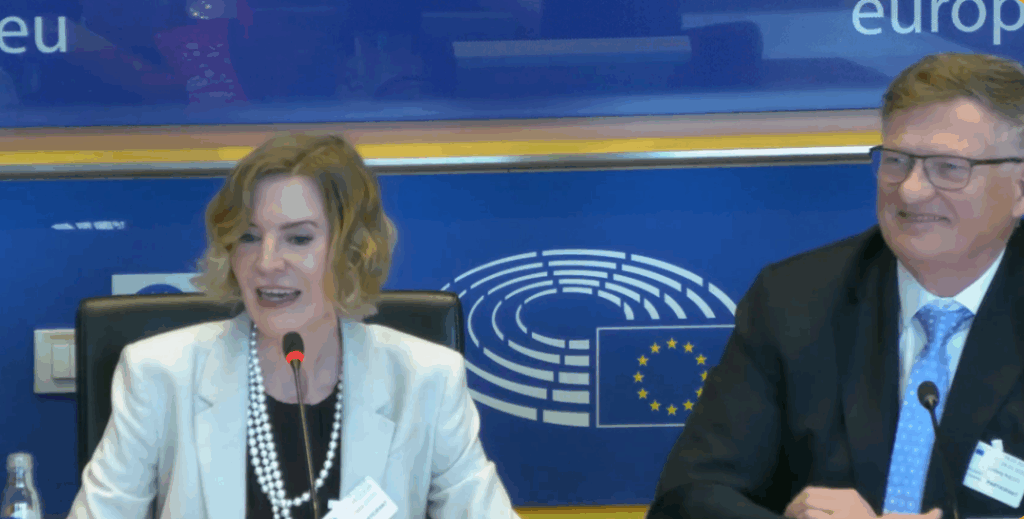
On 24 March 2026, menopause took its place on the European policy agenda. At the European Parliament Public Hearing on “Menopause care in the EU”, EMAS was represented by its President, Prof Petra Stute, and Secretary General, Prof Ludwig Kiesel, invited as expert speakers.
This joint hearing, led by the Committees on Women’s Rights and Gender Equality and Public Health, brought together policymakers and experts to address a long-overdue question: how can Europe better support women through menopause?
A missing pillar in health policy
In her address, Prof Stute highlighted a critical gap:
“Menopause remains a missing pillar in EU health policy, despite affecting the majority of women and up to one-third of their lives.”
She emphasised that while scientific knowledge and clinical guidance are well established, implementation across Europe remains inconsistent:
“The gap is not scientific evidence, it is implementation.”
This gap translates into fragmented care pathways, unequal access to treatment, and persistent stigma, leaving many women unsupported during a significant life stage.
A call for integrated, multidisciplinary care
Prof Kiesel reinforced the importance of recognising menopause across all areas of medicine and healthcare systems:
“Menopause must be recognised across all medical disciplines as a key factor in women’s health and healthy ageing.”
The discussion highlighted the need to move beyond isolated approaches and towards coordinated, multidisciplinary care models that reflect the complexity of menopause and its impact on physical, mental, and social wellbeing.
From evidence to action
The hearing underscored a clear message: menopause is not a niche issue. It is a widespread, systemic challenge with implications for health systems, workforce participation, and gender equality across Europe.
A coordinated European strategy is essential to ensure equitable, evidence-based care for all women — regardless of where they live.
The EMAS community in action
The presence of EMAS at the European Parliament reflects the strength of its community, bringing together science, clinical expertise, and advocacy to shape meaningful change.
As conversations around menopause continue to evolve, EMAS remains committed to advancing knowledge, supporting healthcare professionals, and ensuring that women’s health at midlife is recognised, prioritised, and addressed.


 powered by Borlabs Cookie