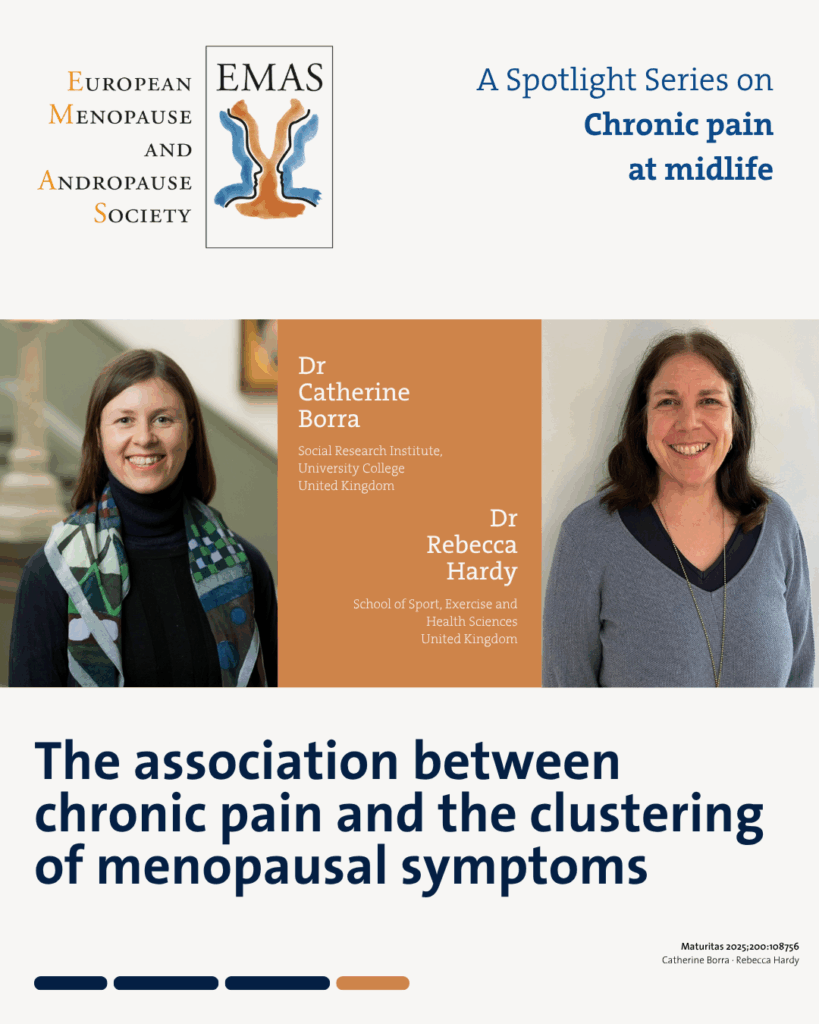
Chronic pain at midlife is the theme for World Menopause Month. We went looking at what has been published on it in Maturitas, found four studies worth reading, and asked the authors to write about their own findings.
A woman arriving at menopause with a history of chronic pain is not starting from the same place as one who isn’t.
Catherine Borra, Social Research Institute, University College London, United Kingdom · Rebecca Hardy, School of Sport, Exercise and Health Sciences, Loughborough University, United Kingdom
Women with existing chronic pain are more likely to experience a high burden of menopause symptoms compared to others.
The link between the two has been observed before, but in cross-sectional studies that assumed symptoms came first and pain followed. The direction was never established. It is equally possible that women with chronic pain before perimenopause go on to experience a greater burden of symptoms around menopause, and that is what we set out to test.
What we did
We used data from the National Child Development Study, a birth cohort of people born in England, Scotland and Wales in one week in 1958. Chronic pain was assessed at age 44, defined as pain lasting longer than three months. Chronic widespread pain was defined using the American College of Rheumatology criteria, as chronic pain with contralateral upper and lower quadrant pain together with spinal pain. A 20-item menopause symptom questionnaire followed at age 50.
Latent class analysis of 4,897 women identified the symptom patterns. Structural equation models in 3,308 women related pain at 44 to those patterns at 50, adjusting for childhood socioeconomic position, education, prior mental health, longstanding illness, gynaecological problems, physical activity and BMI.
What we found
Four patterns of symptom experience emerged at age 50, and they split the sample fairly evenly. A low symptom burden group, 26%. A vasomotor group, 26%. A psychological group, 23%. And a high symptom burden group, 24%.
Chronic pain at 44 was common, reported by 41% of women, with chronic widespread pain in 12%.
Women with chronic pain at 44 had greater odds of being in every higher burden group. The association was strongest for the high symptom burden group, with an odds ratio of 2.90 for chronic pain and 3.50 for chronic widespread pain. For the vasomotor group the odds ratios were 1.50 and 1.93.
Joint aches and pains were the most commonly reported symptom, which raises an obvious question: are these women simply reporting their existing pain again? We repeated the analysis without that symptom. The associations were reduced but held, and women with chronic pain still had more than double the odds of being in the high burden group.
What it means
Women with chronic pain at menopause are not only more likely to report sleep and psychological symptoms, which is already well documented, but also vasomotor symptoms, which are the ones most clearly tied to the timing of menopause.
There is a practical risk attached to missing this. Long-term opioid prescribing has been described among middle-aged women with both chronic pain and menopausal symptoms, which suggests menopausal symptoms in these women may sometimes be treated as pain. Non-pharmacological approaches deserve more attention. Women who are more physically active at midlife report less bodily pain regardless of menopausal status.
A history of chronic pain could be a signal of future health challenges at menopause, making a case for integrating pain management and menopause care.
Read the study
Borra C, Hardy R. The association between chronic pain and the clustering of menopausal symptoms: evidence from a British birth cohort study. Maturitas. 2025;200:108756. Open access.


 powered by Borlabs Cookie